Just How Are Peptides Evaluated? Hplc, Coa & Pureness Explained 2026
Peptide Evaluation Services Every research study peptide provided by Peptides Laboratory UK is separately tested and third-party validated to confirm peptide purity, molecular stability, and authenticity. This makes sure that every vial fulfills the greatest laboratory criteria prior to reaching scientists across the UK and Europe. HPLC purity informs you what portion of the peptide example is the target peptide versus impurities (trimmed series, deletion peptides, oxidation items).
Just how much does peptide HPLC testing cost?
The expense of peptide analysis solution varies substantially based on which strategies your regulative package needs: HPLC-UV Analysis: $& #x 24; 300 & #x 2013; & #x 24; 800 per example (conventional pureness evaluation) LC-MS (Liquid Chromatography-Mass Spectrometry): $& #x 24; 600 & #x 2013; & #x 24; 1,500 per sample (molecular weight verification).
What Are The Significant Components Of Hplc Method Recognition?
Without this testing, it can show to be a lot more challenging to detect the contaminations that might remain in peptide medicines.
Companion with us for trusted HPLC and MS solutions that assure peptide reliability from synthesis to application.
HPLC methods for peptide analysis usage reverse-phase columns with slopes of water and acetonitrile, usually with trifluoroacetic acid as a modifier.
In simple terms, HPLC is how researchers show that a peptide is clean, properly made, and deserving of trust.
Hydrophilic communication chromatography (HILIC) and normal-phase chromatography are also appropriate for dividing polar substances, with HILIC being the preferred approach.
Common pureness levels range between 99.0% and 99.7%, aligning with worldwide research laboratory research study requirements.
Examinations should consist of using validated logical methods to evaluate identity, pureness, strength, and stability at every phase of the item's development and use. We often make use of gradient elution in peptide pureness evaluation, that is, the proportion of organic stage (generally acetonitrile) in the eluent slowly boosts with time. Due to the fact that the rate of enhancement of natural phase has a significant effect on the purity result. We usually utilize a gradient elution method every min (the focus of acetonitrile rises by 1% every minute, v/v), which can prevent the overlap of sample optimals and impurity optimals and enhance the precision of analysis results. This write-up is provided for educational and research study referral functions just.
Regulatory Conformity For Medical Research Studies
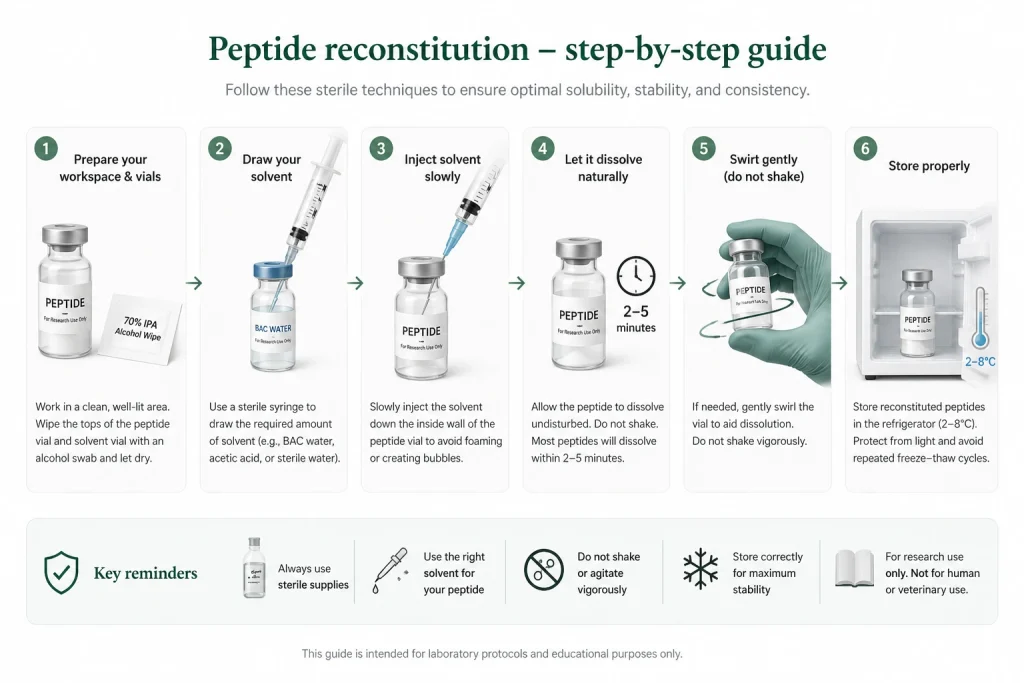
When a brand-new peptide batch features a Certificate of Evaluation, researchers make sure there is a solitary predominant peak in the HPLC output and a high purity percentage. If the peptide is, state, 98% pure by HPLC, they wage confidence; if the HPLC shows multiple sizeable contamination peaks or pureness below ~ 90-- 95%, they might deny or more cleanse that set. The retention time of the primary height is additionally contrasted to expectations or previous sets as an added identity check. By using just HPLC-verified peptides, researchers decrease the danger of confounding variables in their assays. For example, a peptide at 90% purity versus one at 99% pureness can create different organic results. As soon as reconstituted in solution, a lot of peptides need to be used within thirty days when stored at 2-- 8 ° C, or aliquoted and frozen for longer-term storage. NMR supplies a great quantity of info concerning the structure of peptides. A number of strategies are used to test peptides, yet the precise approach depends on what needs to be reviewed, such as purity, framework, or security. Material is supplied Article source as a lyophilized reference compound with HPLC purity verification. NorthEast BioLab provides important insight, and are compliant with governing requirements and market best techniques. By accessing this material, you recognize that you have reviewed and understood this disclaimer. Understanding exactly how to test peptides for purity ensures the reliability and reproducibility of every study protocol. This guide discusses High Quality Peptides the three gold-standard logical methods-- HPLC, mass spectrometry, and third-party screening-- and just how scientists can interpret outcomes to confirm that their compounds fulfill research-grade top quality requirements. Without orthogonal techniques to find these microheterogeneities, they multiply in a system (passing as 'organic irregularity'), reducing signal-to-noise and ultimately revoking entire information sets. Official HPLC/MS characterization freezes that worsening in position, subjecting each particle to 2 orthogonal choice pressures (hydrophobicity and mass-to-charge), developing a statistical firewall program around false identification. Regular purity levels vary in between 99.0% and 99.7%, lining up with worldwide laboratory research standards. These examinations validate that peptides from Peptides Lab UK include no impurities, destruction byproducts, or undesirable fillers-- just confirmed, high-purity research material.